




Skip to content
OHM WORKS MEASURE · ANALYZE · DECIDE
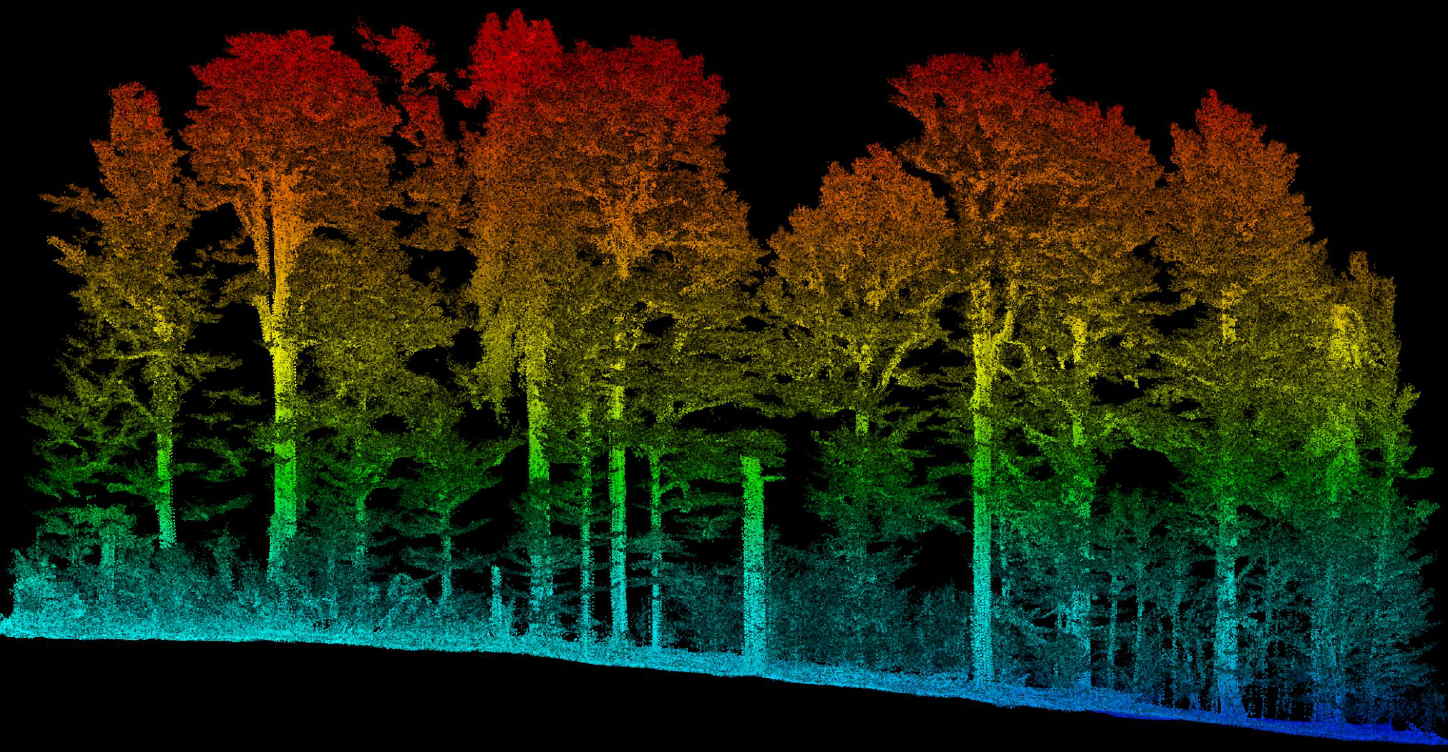
Coupe LiDAR colorisée par hauteur d'un peuplement forestier — pénétration sous canopée par drone OHM WORKS
← All industries

Industry

Forest Management

OHM WORKS deploys airborne LiDAR and multispectral imagery to support forest managers, environmental engineering offices and carbon project developers. Stand inventories over large areas, canopy height models, harvest monitoring and reforestation tracking: reliable data to manage your forests and unlock their value.

Area covered per flight
500 ha/j
Z-axis accuracy
< 5 cm
Standard delivery time
3-5 j

Applications

  • Aerial stand inventory

    Tree counting and characterisation across hundreds of hectares using high-density LiDAR: height, basal area, stand density, dominant species. Data ready for immediate use in forest management plans.

  • Biomass estimation

    Canopy Height Models (CHM) and above-ground biomass computation at plot or stand level. Quantitative basis for carbon studies, REDD+ credits and environmental impact assessments.

  • Harvest planning

    Accurate mapping of mature stands, ecological exclusion zones and access tracks. Optimised extraction plans to reduce impact and maximise productivity.

  • Biodiversity monitoring

    Analysis of forest vertical structure, emergent species detection and sensitive habitat mapping. Data compliant with environmental impact study requirements and management plans.

  • Carbon credits & REDD+

    Carbon sequestration estimation and multi-year stock change monitoring. Reports compliant with Verra / Gold Standard for carbon offset projects.

  • Reforestation monitoring

    Plantation survival control, seedling count, mapping of failed zones. Georeferenced reporting for funders, NGOs and forest restoration project developers.

Counting & plot mapping

Every tree counts, and we count them all

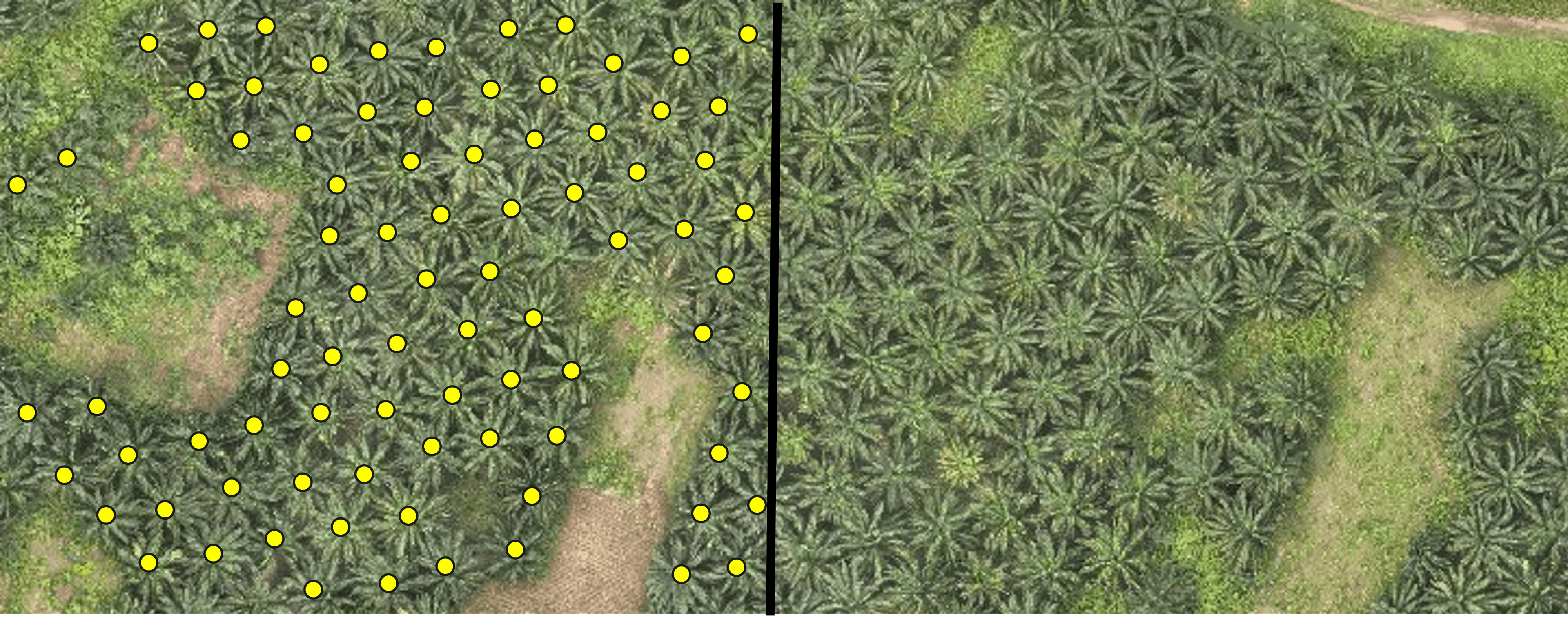
Comptage automatique de palmiers sur orthophoto haute résolution — détection IA

Oil palm count · 60 ha · Alada · Benin

Automatic counting & plot mapping

Plantation inventories without setting foot on the ground

Automated detection of every tree from high-resolution orthophotos — oil palms, rubber trees, fruit trees, eucalyptus. Exhaustive count, identification of missing trees, mapping of gaps and replanting zones. Results delivered as SHP or GeoJSON, importable into any GIS or plot management tool.

  • Exhaustive count with < 2 % error margin on perennial crops
  • Gap and replanting zone detection, quantified to the hectare
  • SHP / GeoJSON / KML deliverables compatible with every GIS toolkit

FAQ · Frequently asked

The questions we hear most often.

How do you count trees in a plantation by drone?

High-resolution orthophoto (GSD 2-4 cm/pixel), then AI detection on the visual signature of crowns. Error margin < 2 % on perennial crops with spaced rows. Each tree is geolocated and delivered as a GIS layer (SHP, GeoJSON).

Does LiDAR measure the height of each tree?

Yes. The CHM (Canopy Height Model) extracted from the high vegetation class of the LiDAR cloud gives the height of each tree to the cm. On the Okpara inventory (200 ha for SoNaMA), we highlighted trees exceeding 17 metres.

Can you compute the biomass of a forest plot?

Yes, by crossing the CHM and the crown surface measured on the orthophoto, calibrated by a few ground dendrometric measurements. Typical margin 10-15 % on total aboveground biomass.

Does the drone detect illegal logging or land clearing?

Yes, by comparing successive campaigns. The CHM differential between two flights reveals zones where canopy has disappeared. Valuable for forest concession monitoring and environmental audits.

Which species are compatible with AI counting?

Oil palm, coconut, date palm, rubber: excellent results. Mixed tropical forest: LiDAR rather than AI counting, as the mixed canopy prevents reliable individual identification. Cocoa under shade: LiDAR to separate cocoa and shade trees.