




Agriculture · AI
Automatically counting palm trees: field report from Alada, 60 hectares
On a 60-hectare plantation in Alada, a drone and one flight day replace a week of ground crew. Technical detail, error margin, and what the count reveals beyond the tally.
- Publication date
- 16 May 2026
- Reading time
- 6 min
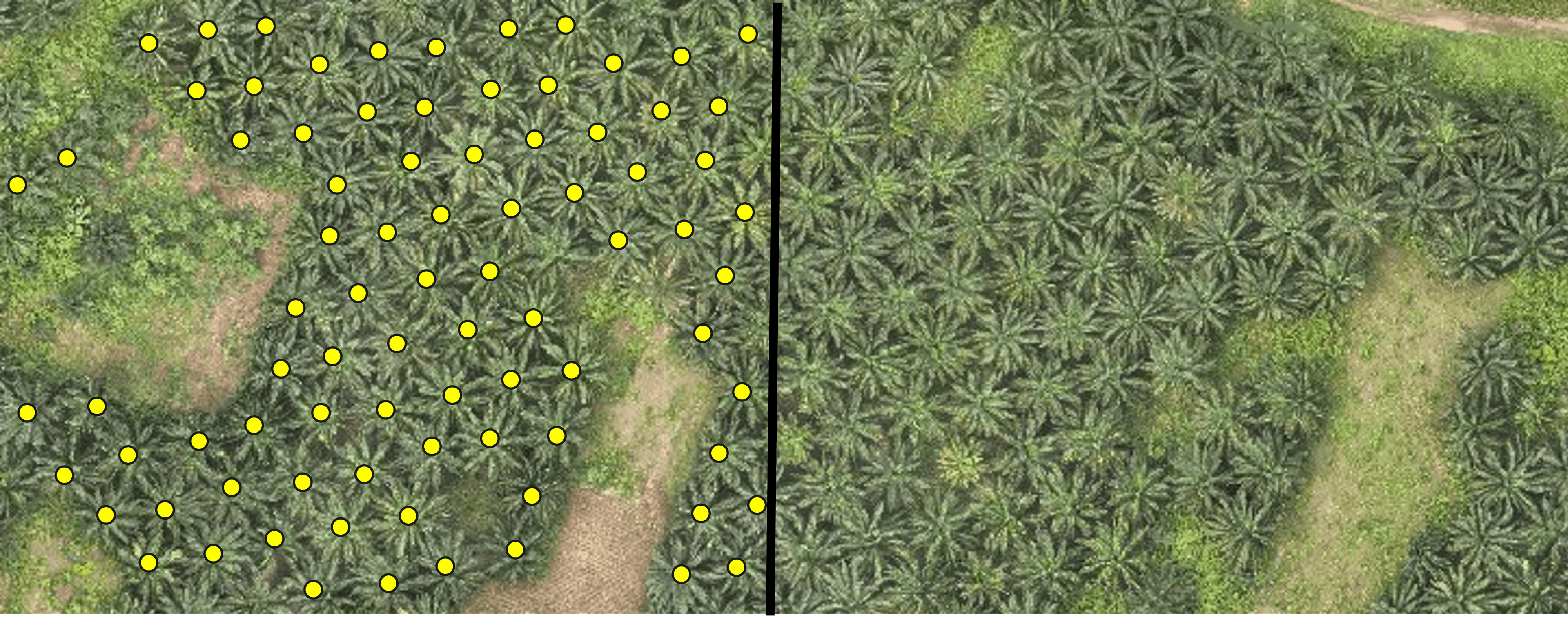
For many operations in Benin, counting trees in a plantation is still a feet-in-the-dirt affair: you grid, you tick, you add up. On 60 hectares in Alada, we replaced that routine with a drone, a half-day flight and three days of analysis. Here is what the mission taught us.
Why manual counting no longer holds up
On a typical West African oil palm plantation, density reaches 140 to 200 plants per hectare. On 60 ha, that means between 8,400 and 12,000 individual trees to inventory if you want a reliable number — not an extrapolation from a few sample plots.
Using the classic method, the inventory mobilises a team of at least four people for 4 to 6 days, sometimes more if topography makes gridding harder. And even after that effort, the result suffers from three well-known biases:
- Under-counting of edge trees (ambiguity in plot assignment, plain omissions).
- Double-counting on dense rows where canopies overlap.
- No geolocation of missing trees — you know how many there are, but not exactly where they are, so the replanting map has to be drawn by hand too.
And above all, the report is static. Six months later, you have to start over.
The drone method: AI detection on a high-resolution orthophoto
The principle is simple to state, more subtle to execute. We first produce a high-resolution orthophoto of the plantation (typical GSD of 2 to 4 cm/pixel — each pixel represents 2 to 4 cm on the ground). On this orthophoto, an object detection model identifies each palm crown individually, exploiting the distinctive star-shape signature of the fronds.
The models used are trained specifically on aerial imagery of tropical plantations — oil palm, date palm, coconut palm or rubber depending on the crop. Accuracy typically reaches an error margin below 2 % on perennial crops with spaced rows, and stays around 3 to 5 % on very dense plantations or plantations still closing canopy.
Each detection is precisely geolocated (RTK + GCP — see our LiDAR article for the protocol detail). The final deliverable isn't just a number — it's a GIS layer (.shp, .geojson) with one point per palm, its unique ID, its XY coordinates, and a detection confidence score.
Field report — 60 hectares in Alada
The plot, located in the Alada area (southern Benin), held a young oil palm plantation in regular rows, with a few zones earmarked for replanting. Client brief: count, geolocate the missing trees, and produce a cartographic base usable in their internal GIS.
| Step | Duration | Resource |
|---|---|---|
| Brief & zone analysis (ANAC clearance, flight plan) | 1 h | GIS engineer |
| 6 GCP layout + drone flight | Half-day | 1 ANAC pilot + 1 assistant |
| Photogrammetry & orthophoto generation | 1 day | Processing station |
| AI detection + visual QC | 1 day | GIS engineer |
| Report + delivery SHP / GeoJSON / KML | Half-day | GIS engineer |
| Total | 3 working days + half-day on site | 2 people max on site, 1 engineer remote |
By comparison: the same mission with a ground team would have mobilised 4 people for 5 to 6 days, without the georeferenced GIS layer, without the cartographic base, and without the option of reusing the data for vigour or health analyses.
Beyond the count: what drone data unlocks
Counting is the most visible use, but rarely the most valuable analysis. Once the orthophoto and point cloud are in hand, you can additionally produce:
- Vigour map (NDVI) if a multispectral sensor was flown — detect stressed or diseased trees before they become visible to the naked eye.
- CHM (Canopy Height Model) via photogrammetry or LiDAR — every palm gets a measured height, useful for planning harvests or estimating tree age.
- Mapping of gaps and replanting zones, costed to the hectare.
- Early disease detection with visual signature (red weevil, Cercospora yellowing, etc.) by comparing successive campaigns.
- Temporal growth tracking via annual drone revisit — valuable on young plantations still closing canopy.
Applications by crop type
Oil palm
Average density 140-200 plants/ha. Very legible visual signature (star-shaped fronds). Counting and NDVI well suited. Annual or biannual flight cycle to track the growth of a young plantation.
Coconut
Lower density (80-120 plants/ha), plantations often less regular along the coast. Detection works well but sometimes requires model tuning to distinguish young coconuts from intercropped plants.
Rubber
Rectilinear plantations, high density (450-550 plants/ha on young plots, less at maturity). Very accurate counting until canopy closes. Beyond full coverage, analysis shifts towards canopy mapping rather than individual counting.
Cocoa
More complex: variable density, plantations often under forest shade trees, diffuse canopy. LiDAR then becomes interesting to distinguish cocoa from shade trees by analysing heights.
Who it's worth it for
For any operation above 30 hectares in perennial crops, switching to drones pays off from the first campaign. For smaller surfaces, it depends on the desired frequency: if you want to monitor the plantation every year with usable georeferenced data, drones remain competitive even on 10 ha.
The most interesting long-term investment isn't the one-off count, it's the establishment of a georeferenced reference dataset you can return to every year. After 3 years of tracking, the plantation becomes a system you steer — not just an asset you inventory.
Ready to switch to drones?
Let's discuss your project in 30 minutes.
Firm quote within 48 hours. Coverage across Benin, West Africa and France. XY accuracy < 3 cm, volumetric tolerance ± 1 %.