




Technology · LiDAR
Airborne LiDAR in Benin: how it actually works
LiDAR penetrates the canopy, reconstructs the bare ground and models structures with centimetre accuracy — no climbing, no clearing. Here's how OHM WORKS runs the sensor on Beninese sites.
- Publication date
- 16 May 2026
- Reading time
- 8 min
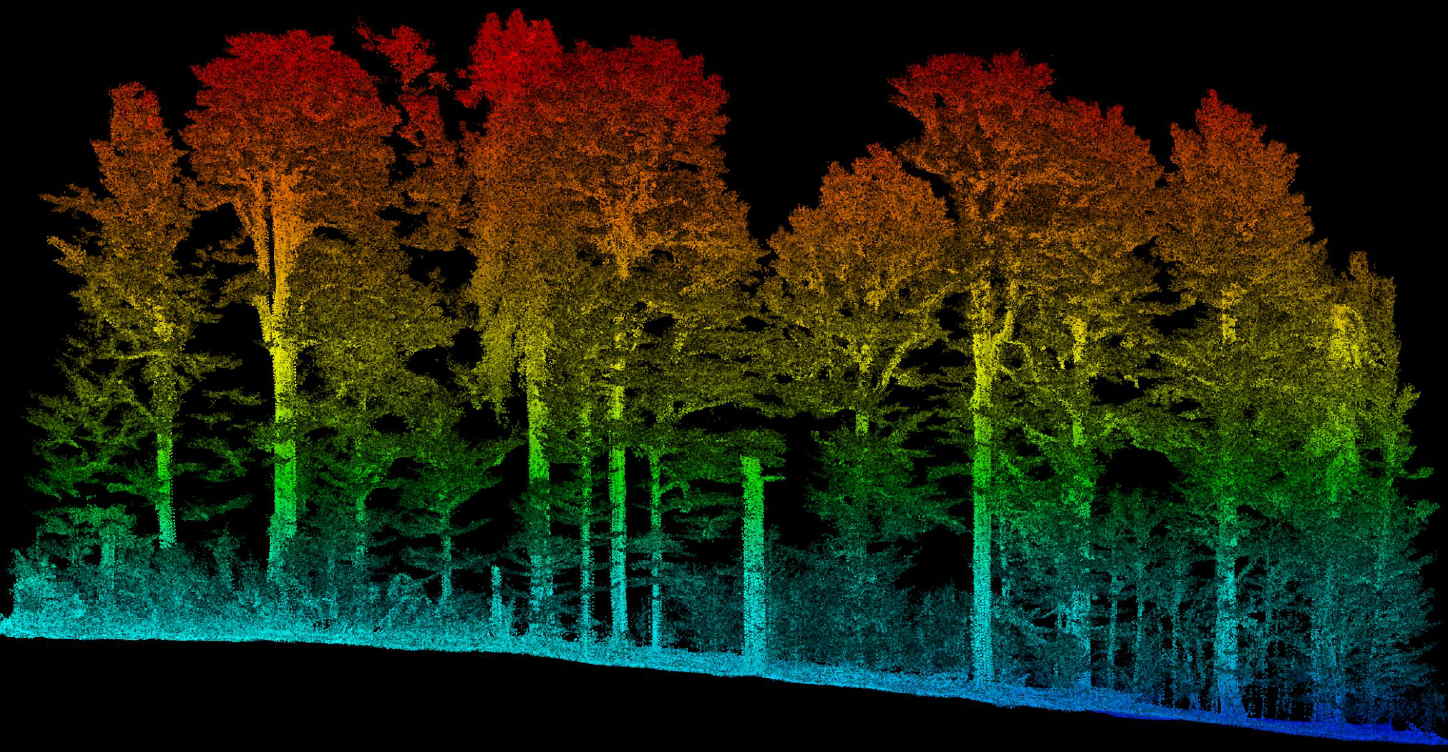
Airborne LiDAR is the only survey technology that penetrates the canopy and reconstructs the bare ground at the same time as the structures sitting on it. On Beninese ground — dense palm groves, wooded plots, heritage sites with invasive vegetation — it is often the only way to get centimetre-accurate data without clearing anything or sending a ground team in. Here is how OHM WORKS operates the sensor, what we actually get out of it, and when it earns its price tag compared to photogrammetry.
The physics, in two sentences
LiDAR (Light Detection And Ranging) emits laser pulses at very high frequency — on the order of a million points per second on current sensors — and measures the return time of each pulse. Because the drone's altitude and orientation are known in real time thanks to the on-board GNSS-RTK + IMU pair, each returned point is positioned in XYZ coordinates with an absolute accuracy of roughly 2 to 5 cm.
The crucial difference with photogrammetry: each pulse can produce several returns. The first return bounces off the top of a tree, the following ones penetrate through the leaves and eventually hit the ground. This very ability lets us produce a Digital Terrain Model under a forest without cutting down a single tree.
LiDAR or photogrammetry: how to decide
The question comes back on every mission. The two technologies don't overlap — they answer different questions:
| Criterion | Photogrammetry | LiDAR |
|---|---|---|
| Penetration under canopy | Impossible | Excellent |
| Acquisition cost | Low | High (sensor + processing) |
| Real texture / colour | Native (RGB) | No (monochrome laser) |
| Typical point density | 30-100 pts/m² | 10-50 pts/m² (useful) |
| Z accuracy on bare ground | 3-8 cm | 2-5 cm |
| Lighting conditions | Sunlight required | Irrelevant (night-time too) |
In practice, on an open building site, photogrammetry is more than enough and costs less. The moment you need the ground under a coconut grove, the bed of a watercourse in the mangrove, or the immediate environment of a high-voltage line buried in vegetation, LiDAR becomes mandatory.
Point density, multi-return and classification
Once the raw data is in hand, the real work begins. A raw LiDAR cloud contains millions of undifferentiated points. To make it usable, we classify it: ground, low vegetation, mid vegetation, high vegetation, built structures, power lines, outliers. This classification relies on algorithms (CloudCompare, Pix4D, LASTools) that exploit the multi-return notion: a point that triggered a second, lower return is probably vegetation, not ground.
From the extracted "ground" class, we generate a Digital Terrain Model (DTM); from the "high vegetation" class, a Canopy Height Model (CHM) that directly gives the height of each tree. These two models are the foundation of almost every analysis that follows: cross-sections of a forest road, biomass calculation, erosion detection between two campaigns, vegetation clearance planning under a power line.
How OHM WORKS runs a LiDAR flight in Benin
The protocol fits in four steps — always the same, whether we are on 30 hectares or 200. The consistency is what guarantees the final accuracy.
- Technical brief and zone analysis. Perimeter definition, ANAC constraints (restricted area, NOTAM to publish if needed, SORA analysis for specific operations), sensor selected based on the type of cover and expected deliverable.
- Field preparation. Layout of GCP (Ground Control Point) targets georeferenced via GNSS RTK with centimetre accuracy. This setup anchors the whole point cloud in an exploitable coordinate system (default EPSG 32631 / UTM Zone 31N for Benin).
- Flight. Trajectories planned with a minimum 50 % overlap between lines to guarantee uniform coverage. ANAC Bénin + DGAC France certified pilot, double-check of flight plan and weather. For a 60 ha area under dense cover, count half a day of effective flying.
- Processing. Fine trajectory computation (GNSS post-processing), pass merging, cloud classification, DTM generation, CHM generation and sector-specific deliverables (inventory report, profiles, sag measurements, etc.). Typical lead time: 3 to 5 days after acquisition.
Real case: 100 hectares of LiDAR on the Royal Palaces of Abomey
For the Agence Nationale des Patrimoines Touristiques (ANPT), OHM WORKS carried out a complete LiDAR survey of the UNESCO World Heritage site of the Royal Palaces of Abomey, over 100 hectares including walls, built volumes, tree canopy and surroundings. The deliverable: a classified point cloud, a centimetre DTM, a canopy CHM and a textured 3D model of the most emblematic structures.
The site's challenge wasn't the surface — which photogrammetry could have covered — but the heterogeneous vegetation hiding collapsed perimeter walls, residual foundations and historic paths. Only LiDAR could map the archaeological structures under cover without any ground intervention, on a heritage-protected site where excavators are out of the question.
When LiDAR is worth its price
LiDAR costs 3 to 5 times more than an equivalent photogrammetry mission — mechanically: more expensive sensor, more data to process, more GIS engineer hours. It earns its price when the question is impossible to answer any other way:
- Topography under forest cover (road planning, hydraulic study, archaeological inventory)
- Power line inspection (sag measurement, vegetation clearance, cable spacing) over linear features of several kilometres
- Tree-by-tree forest inventory with biomass calculation
- Heritage modelling of a site where vegetation has overgrown the structures
- 3D mapping of the environment around a telecom tower or industrial site for extension planning
Conversely, for monitoring an open construction site, calculating a stockpile volume or producing a cadastral orthophoto, aerial photogrammetry remains the most relevant tool — sufficient accuracy, controlled cost, faster deliverables.
What to take away
Airborne LiDAR is not a gimmick. It's a precision measurement technology that opens up questions photogrammetry can't answer. In Benin and West Africa, where historical mapping under canopy is patchy and where infrastructure projects often cross vegetated zones, LiDAR offers a significant operational edge — provided it is operated by a team that masters the post-acquisition processing as well as the flight itself.
Ready to switch to drones?
Let's discuss your project in 30 minutes.
Firm quote within 48 hours. Coverage across Benin, West Africa and France. XY accuracy < 3 cm, volumetric tolerance ± 1 %.