




Telecom · Inspection
Telecom tower inspection by drone: 30 minutes vs a full climber day
Complete capture of a tower in a single session, no radio shutdown, no climber, no cherry picker. Cost-time-risk comparison vs the classic method, and what we document down to the bolt.
- Publication date
- 16 May 2026
- Reading time
- 7 min
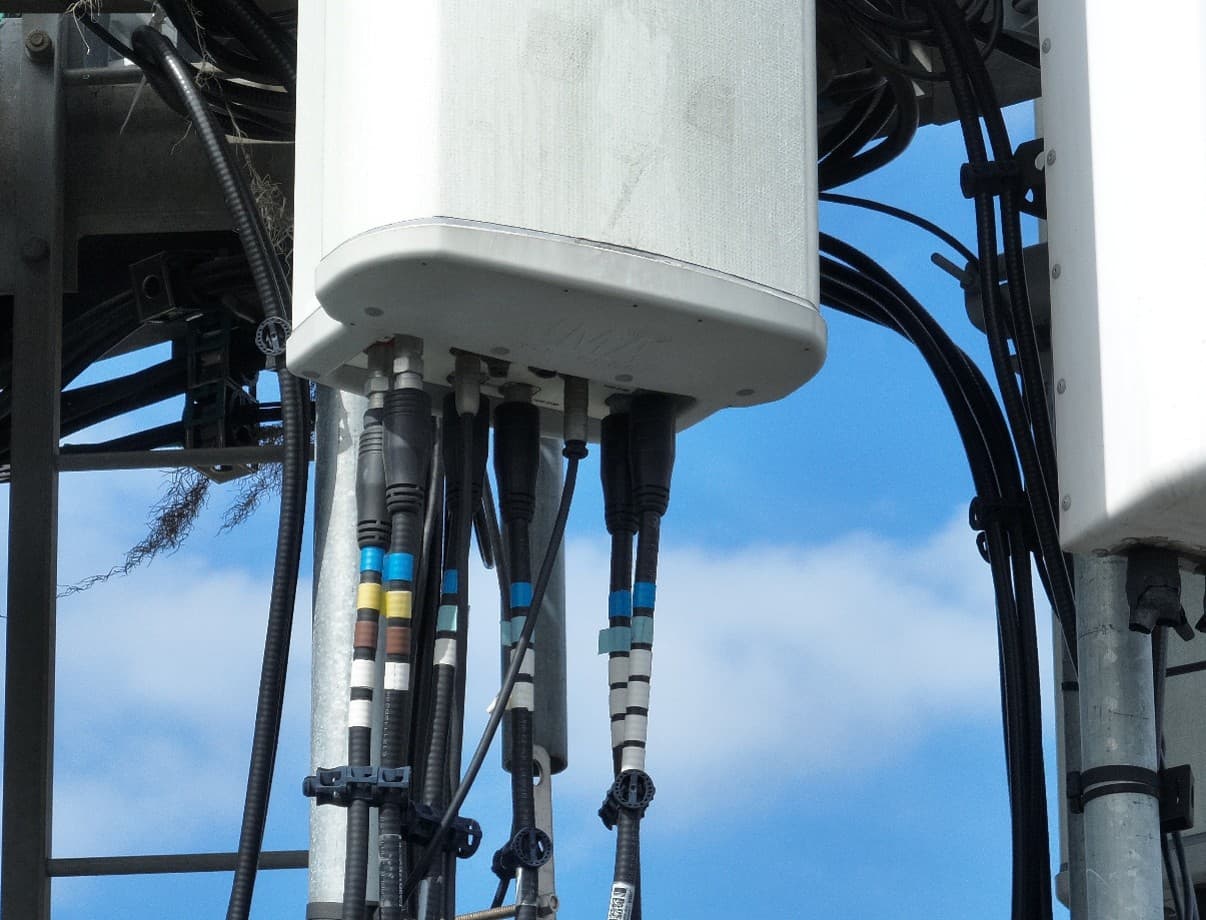
A team of climbers on a telecom tower means a day-long operation, several people mobilised, a specific insurance, and a human risk that never fully goes away. A drone means 30 to 60 minutes of flight, one pilot on the ground, and a complete photographic and 3D deliverable of the same tower — often more detailed than what a climber would have brought back. Let's compare, with numbers.
The hidden cost of the classic method
For a complete audit of a 30 to 50 metre telecom tower, the traditional procedure typically mobilises:
- 2 to 3 qualified rope-access technicians (CQP, radio clearance)
- A full day of mobilisation
- Coordination with the telecom operator to authorise access
- In some cases, temporary radio shutdown to reduce electromagnetic exposure for the operators at the top of the tower
- A Civil Liability insurance specific to working at height
Beyond the direct cost — running into thousands of euros per audit depending on the country — two hidden costs really weigh:
- Service interruption or temporary capacity drop during the operation, translating into revenue loss for the operator on the most-used sites.
- Residual human risk. Working at height on a metal structure remains, by industry statistics, one of the telecom sector's most accident-prone activities. A fall means a health-and-safety inquiry, the site shut down, and a file that drags on for months.
The drone: 30 minutes, no climber, no shutdown
On a standard tower, a complete drone inspection flight takes 30 to 60 minutes of effective capture, excluding perimeter safety. The pilot operates from the ground, at a respectful distance from the structure, flying a drone equipped with a high-resolution photogrammetric sensor and — depending on the mission — an infrared thermal sensor.
Capture follows a precise protocol: an external orbit at medium distance for the overview, several closer orbits at different heights (typically every 5 to 8 metres), and finally close-ups on each antenna, each technical bay, each cable connection. The result: between 800 and 1,500 high-resolution photographs covering each element of the tower from several angles, plus — if a thermal sensor was flown — a complete mapping of surface temperatures.
| Criterion | Climber method | Drone method |
|---|---|---|
| Operation duration | 1 day | 30-60 min flight |
| People mobilised | 2-3 climbers | 1 pilot |
| Radio shutdown | Often necessary | None (drone produces no radio noise) |
| Human risk | Work at height | Pilot on the ground |
| Documented coverage | Spot photos | 800-1,500 photos + 3D |
| Dimensional measurements | Tape / inclinometer | Computed on the 3D model |
| Thermography | Non standard | Native (IR sensor) |
| Sites per mission day | 1 | 4-6 depending on grid |
| Report lead time | 1-2 weeks | 3-5 days |
The OHM WORKS protocol
Phase 1 — Scoping and clearances
List of sites to inspect, GPS coordinates, owning operator, ANAC constraints (controlled airspace, distance to airstrips), sensor choice (RGB high resolution always, IR thermal depending on mission). Firm quote within 48 hours.
Phase 2 — Hover-and-capture high resolution
For each tower, the pilot follows an ascending spiral trajectory with hover stops at the level of the main equipment. Capture uses a photogrammetric redundancy protocol: each antenna face is imaged from at least three different angles, enabling both 3D modelling and precise identification of each piece of equipment.
The drone remains at a safety distance from the structure (typically 4 to 6 metres) to avoid aerodynamic interference with guys and antennas. Photogrammetric accuracy at this distance is enough to identify millimetric elements (screws, connector condition).
Phase 3 — Modelling and report
Photogrammetric processing under Metashape or Pix4D to generate the textured 3D model of the tower, compute antenna positions in georeferenced XYZ, and enable dimensional measurements inside the model. Photograph annotation by defect criticality (corrosion, degraded insulation, loose fixing, missing equipment). If a thermal sensor was flown: overlay of detected hotspots with precise location on the structure.
What gets documented — down to the bolt
Drone inspection produces a noticeably more comprehensive audit file than a climber operation. On each inspected tower, we deliver:
- Annotated RGB photographs — each antenna and each connection, with criticality per detected defect (corrosion, insulation, fixing, conformity with site datasheets)
- Textured 3D model of the full tower, navigable and measurable
- Dimensional measurements — actual tower height, azimuth and tilt of each antenna, georeferenced XYZ position of technical bays, frame dimensions
- Thermal mapping (if applicable) — hotspots on contacts, connections, technical bays, with delta-T gap to ambient
- Geolocated inventory compliant with the site datasheets — every present equipment is listed, every expected but missing one is flagged
- Structured PDF report, plus a GeoJSON / KML / IFC export for the client's GIS or CMMS use
Full measurements without climbing
One of the recurring questions from network managers: how do you validate azimuth (an antenna's horizontal orientation) and tilt (vertical inclination) without climbing with an inclinometer? The answer is in the georeferenced photogrammetric 3D model.
Each antenna is extracted from the model as an oriented volume. Orientation is computed against true north (azimuth) and against the horizontal plane (tilt). Accuracy on these measurements is typically within a degree — enough to detect off-spec antennas or slow tilt drifts caused by wind. No climber. No intervention on the antenna. Auditable documentation.
Savings and operational gains
On a fleet of 100 towers to inspect on an annual cycle, switching from climber to drone method typically translates into:
- 60 to 80 % savings on inspection cost per site
- Campaign closing time reduced by a factor of 4 to 6 (4-6 towers per day instead of a single one)
- Total elimination of fall risk on audit missions (climbers remain useful for curative interventions, not for regular audits)
- 10× more complete documentation per site — reusable in case of dispute, infrastructure resale or equipment modification
When drone inspection isn't enough
Let's be precise: drones don't replace everything. For curative work — replacing an antenna, updating a radio module, connecting a new cable — you always need a climber. For regular audit, on the other hand, drones have become the reference method at most European and North American operators. The West African region is on the same trajectory, a few years behind. Better take the lead.
Ready to switch to drones?
Let's discuss your project in 30 minutes.
Firm quote within 48 hours. Coverage across Benin, West Africa and France. XY accuracy < 3 cm, volumetric tolerance ± 1 %.