




Mining & Quarries
Drone stockpile volumetrics: a guide for West African mining operators
How to move from a weekly manual inventory to a few-hour drone audit, ±1 % tolerance, compliant with month-end requirements. Method, equipment, real-numbers ROI.
- Publication date
- 16 May 2026
- Reading time
- 7 min
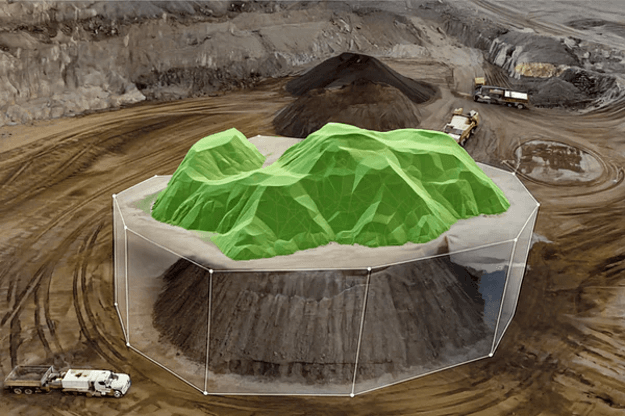
On a mining site or a quarry, the number that really matters is volumetric: how many tonnes in the stockpile, how many cubic metres extracted this month, how many cubic metres of backfill left to place. For decades, the standard method has been the ground topographic survey — accurate, but slow, expensive and risky for the operators sent to climb the heaps. Drones change the equation. Here's how.
The traditional method: accurate, but what it really costs
A ground survey on a 5,000 m² stockpile typically mobilises two survey technicians and a vehicle for two to three days, plus the processing desk. Direct cost runs into thousands of euros per campaign; the indirect cost is more insidious:
- Partial halt of operations during the survey for safety reasons — machines parked, teams forced to wait.
- Non-negligible operator risk: walking on an unstable pile of ore or rubble remains an accident-prone activity.
- Limited spatial sampling. A hundred points or so are measured per stockpile — the volume calculation is an interpolation between those points, not an exhaustive measure.
- Low frequency. Given the cost, sites are often surveyed once a quarter, sometimes monthly. It's hard under such conditions to finely reconcile material outflow with physical inventory.
The drone method: ± 1 % tolerance, in a few hours
A photogrammetric flight over the same stockpile produces tens of millions of 3D points — almost a continuous measure of the surface. The resulting volume calculation is itself much finer, with a volumetric tolerance on the order of ± 1 % on measured volumes.
In practice, for a typical site (10 stockpiles, 20 ha):
| Step | Ground method | Drone method |
|---|---|---|
| Preparation | 2 h (planning, safety briefing) | 1 h (zone analysis, NOTAM) |
| Field acquisition | 2-3 days, 2 people | 3-4 hours, 1 pilot |
| Processing | 1-2 days | 1-2 days (parallel to other ops) |
| Volumetric accuracy | ± 2-3 % (interpolation) | ± 1 % (dense measurement) |
| Estimated total cost | €3,000 - €5,000 | €1,500 - €2,500 |
| Operations downtime | Significant | Near zero |
| Operator risk | Present | None (remote pilot) |
The OHM WORKS protocol, step by step
1. Scoping and zone analysis
Technical brief with the operations director or topography manager: perimeter, desired frequency (monthly, quarterly, one-off), existing reference points, ANAC constraints (restricted zone, distance to airstrips), accuracy requirements. A firm quote goes out within 48 hours.
2. GCP layout
Before each flight, 5 to 8 GCP (Ground Control Point) targets are spread across the site and geolocated via GNSS RTK with centimetre accuracy. These targets anchor the whole point cloud in the client's coordinate system (UTM 31N by default, but we adapt to site-specific mining datums). Without GCPs, absolute accuracy drops to 30-50 cm; with GCPs, we hold 2-3 cm in XY and 5 cm in Z.
3. Photogrammetric flight
Trajectories planned as a double grid (cross-passes) with 80 % forward and 70 % side overlap. This over-overlap guarantees photogrammetric alignment robustness at processing time. For a typical 20-hectare site, the flight takes 90 minutes to 2 hours, excluding safety and transition time.
4. Processing and volume calculation
Photogrammetry under Agisoft Metashape or Pix4D depending on the mission: alignment, optimisation, dense cloud generation, 3D triangulated mesh on each heap. Volume is computed between the mesh surface and a reference plane (surrounding ground, or a manual plane defined by the client). For each stockpile, the report produces:
- Gross volume (m³) with estimated tolerance
- Ground surface covered (m²)
- Maximum height, mean height
- Georeferenced centroid coordinates
- Differential vs previous campaign (if comparison requested)
How we hit ± 1 %
The number isn't marketing. It comes from three technical choices we have never compromised on:
- Systematic, RTK-georeferenced GCPs. No "GCP-less" flights, even on small sites. Absolute accuracy starts on the ground.
- Double grid with over-overlap. 80/70 minimum, sometimes 85/75 on terrain with strong relief where photogrammetric shadow zones are numerous.
- Post-processing QC. Before delivery, we systematically check calibration residuals on GCPs, inspect the mesh for holes and artefacts, and cross-check the computed volume against an independent manual estimate.
The real ROI for an operator
On an average site — say a granulate quarry 100 km from Cotonou or an artisanal gold mine in Niger — gains line up on multiple fronts:
- Direct savings of roughly 30-50 % per campaign vs traditional ground survey.
- Frequency multiplied by 4: you can move from quarterly inventory to monthly tracking, even weekly on strategic sites.
- Much finer stock reconciliation. Many sites discover a "phantom" material gap of 2 to 5 % on the very first drone campaign — typically linked to historical over-estimates from ground interpolation.
- Safety. No operator needs to climb an unstable pile any more.
- HSE compliance traceability. Every campaign leaves a point cloud and an archivable report, usable in case of audit or client dispute.
Beyond volumes: what drone data unlocks
Once the drone is flown regularly on the site, derived applications come naturally:
- Temporal evolution tracking via cross-section comparison between campaigns — useful for analysing open-pit progress.
- Blasting planning with pre-measurement of the volume to mine on a working face.
- HSE mapping of risk zones (slopes, unstable faces, degraded access).
- Environmental audit of a riverbank or a rehabilitated zone.
- Communicative 3D modelling for authority reports or investor presentations.
Who it's worth it for, and who less so
Drones are worth it as soon as there's a volume to measure regularly and more than 2-3 stockpiles on the same site. For a single small heap measured once a year, the ground team remains competitive. But as soon as we talk monthly frequency or several zones, the drone wins on every criterion — cost, accuracy, safety, report delivery speed.
In Benin and West Africa more broadly, mining operations and quarries often stay on quarterly inventories because the cost of a ground campaign is too high to do better. This is precisely the window where drones change the rhythm — not just because they cost less, but because they make possible a level of monitoring no traditional topo office could sustain over time.
Ready to switch to drones?
Let's discuss your project in 30 minutes.
Firm quote within 48 hours. Coverage across Benin, West Africa and France. XY accuracy < 3 cm, volumetric tolerance ± 1 %.